
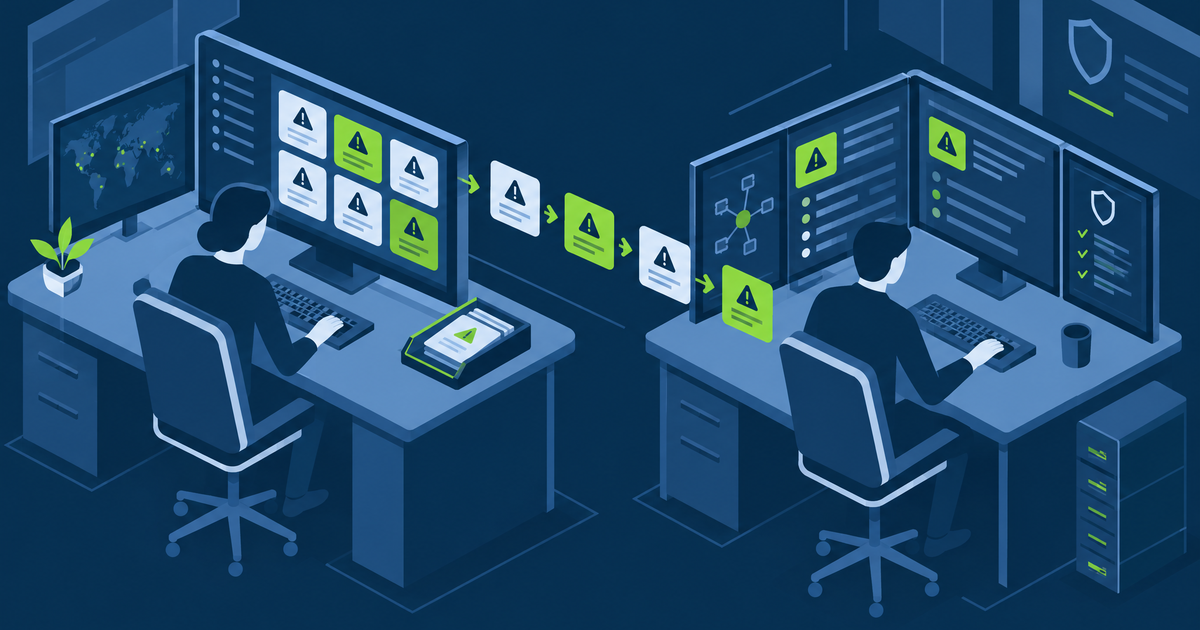
MDR vs MSSP: Which One Actually Responds When Something Happens
One forwards you alerts. The other acts on them. The distinction is blurred in marketing and decisive at 3am.
GuardsArm Team
Security Experts
Both acronyms describe someone else watching your security for you, and both are used loosely enough that a provider can call itself either. The difference that matters is simple to state and hard to get a straight answer on: when something bad happens, does the provider act, or do they tell you?
The traditional MSSP model
Managed security service providers grew out of device management. The original proposition was that running firewalls, intrusion detection and log collection around the clock was specialised work most organisations should outsource.
That model is built around your technology and your response. The provider manages devices, monitors what those devices produce, and escalates what looks significant. The escalation lands with your team, who investigate and decide what to do.
This works when you have a team to receive it. It fails when you do not — which is the situation most organisations buying security monitoring are actually in. An alert forwarded at 3am to an inbox nobody reads until Tuesday is not monitoring in any useful sense.
The MDR model
Managed detection and response was defined against that failure. The provider brings the detection technology, operates it, investigates alerts themselves, and — critically — is authorised to take containment action without waiting for you.
The authority is the product. A provider who can isolate a compromised host at 02:40 stops an intrusion; one who emails you about it at 02:40 has documented an intrusion.
Side by side
| Traditional MSSP | MDR | |
|---|---|---|
| Technology | Yours, managed by them | Usually theirs, included |
| Primary output | Alerts and reports | Investigated incidents, and action taken |
| Response authority | None — they escalate | Contracted containment actions |
| Investigation | Limited triage | Full investigation before contact |
| Threat hunting | Rare | Expected |
| Detection engineering | Static rule sets | Continuously updated |
| What you need internally | A team to act | Someone to accept a phone call |
| Pricing basis | Devices, log volume | Endpoints, users, or assets |
The bottom-left cell is the one to sit with. If you are buying because you have no security team, an MSSP relationship recreates the problem you were solving: you still need someone competent, awake, and authorised.
Where the labels mislead
Many providers now market as MDR because the term sells better, while delivering the older model. The way through is to ignore the label and ask operational questions:
- What actions may you take on my systems without asking me first? Get the list in writing — host isolation, account disable, IP block, process kill.
- Who investigates before I am contacted? A named tier, or an automated forward?
- What is your mean time to contact a human, not to generate a ticket?
- Do you write new detections, and how often did you last year?
- What happens if I do not answer the phone? The answer reveals whether they can act alone.
See MDR pricing for how these differences show up in a quote.
Which one you actually need
Choose MDR if you have no 24/7 security capability, your team is small or generalist, you need containment rather than notification, or your regulatory position requires a short reporting clock you cannot currently meet.
An MSSP relationship can work if you have a functioning internal security team that wants device management and log handling taken off their plate, you have significant investment in tooling you intend to keep, or you have compliance-driven monitoring needs with an internal team to act.
Consider a hybrid where you run business-hours capability internally and buy out-of-hours coverage. This is common and sensible for mid-sized organisations, and it concentrates the expensive part of the problem — nights, weekends and holidays — on the party best placed to staff it. See build, buy or hybrid.
The question that settles it
Ask a prospective provider to walk you through a real incident from last quarter, redacted: what fired, who looked at it, what they did, when the client was told, and what the client had to do. A genuine MDR provider has that story ready. An alert-forwarding service tells you about their dashboard.
GuardsArm provides MDR with contracted containment authority. See MDR services or book a scoping call.
Written by GuardsArm Team
Our team of cybersecurity experts brings decades of combined experience in penetration testing, compliance auditing, and incident response. We're dedicated to helping organizations strengthen their security posture.
Take the next step on this topic
Talk to the GuardsArm team about how these services apply to your environment.