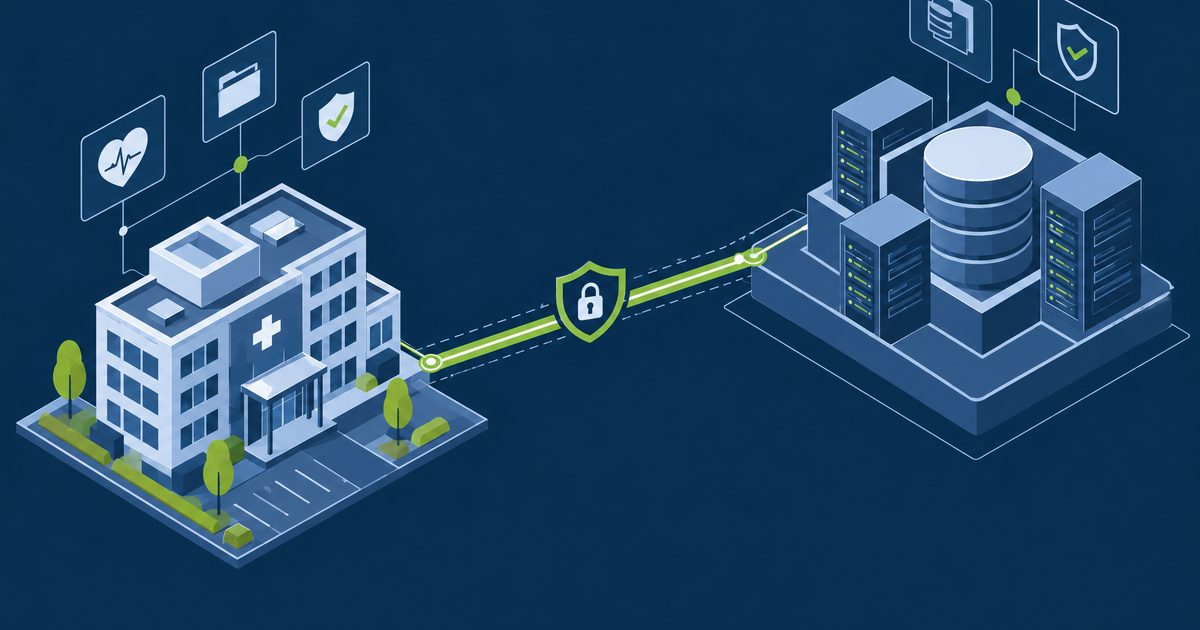

Secure API Integrations With Payers: Protecting Claims Data
Claims traffic carries diagnoses, procedures and identifiers to organisations outside your control, continuously. Authentication, scope, and knowing what you actually send.
GuardsArm Team
Security Experts
Claims and eligibility traffic is the highest-volume flow of identified health data most hospitals operate. It runs continuously, it carries diagnoses and procedures alongside full identifiers, and it goes to organisations whose security you do not control. It is also, almost universally, configured once and never revisited.
Authentication, in order of preference
| Method | Verdict |
|---|---|
| Mutual TLS with client certificates | Best. Certificate is bound to infrastructure and expires by design |
| OAuth 2.0 client credentials, short-lived tokens | Good, and increasingly the standard |
| API key in a header, over TLS | Workable if rotated and stored properly |
| Username and password in the payload | Legacy; replace |
| IP allow-listing alone | Not authentication — use as a supplement |
Most estates run a mixture, because each payer dictates its own method. The practical goal is not uniformity but knowing which is which, and holding the weakest ones to compensating controls.
Send the minimum
Payer transactions are standardised, which creates a habit of sending the full permitted set rather than the necessary one. Eligibility checks in particular often carry far more than they need.
Credential and certificate lifecycle
The failure mode here is operational rather than cryptographic:
- Inventory every integration credential with an owner and expiry
- Monitor certificate expiry — an expired payer certificate takes down claims submission and revenue with it, so this gets attention only when it breaks
- Rotate on a schedule, tested in a lower environment first
- Rotate on staff departure where a person held the secret
- Store in a secret manager, not a configuration file in source control
- Separate credentials per environment, so a test system cannot submit real claims
Monitor the boring traffic
These integrations are so routine that nobody looks at them, which is exactly what makes them useful to an attacker. Worth alerting on:
- Volume anomalies — a step change in transaction count in either direction
- Off-hours activity where the integration has a defined schedule
- Response anomalies — a spike in rejections can indicate tampering or an upstream compromise
- New destinations — any outbound connection from the integration host to somewhere it has not been before
- Authentication failures, which should be near zero for a machine integration
A machine-to-machine integration has extremely predictable behaviour, which makes anomaly detection unusually effective here compared with human traffic.
Third-party clearinghouses
Many hospitals do not connect directly to payers at all but through a clearinghouse — which means a single intermediary holds claims data for the entire organisation. That concentration deserves proportionate diligence: a BAA, evidence of their security posture, clarity on subcontractors, and a documented understanding of what they retain and for how long.
Recent history has shown that a clearinghouse outage or compromise is an organisation-wide revenue and privacy event, not a vendor issue. Plan for it in continuity terms as well as contractual ones.
Testing an integration you cannot break
Claims integrations carry revenue, so nobody wants to test them. That caution is why they go unexamined for years. The way through is environment discipline:
- Payer test endpoints exist for most major payers and clearinghouses — use them rather than validating against production
- Separate credentials per environment, so a test run can never submit a real claim
- Synthetic member data, never a copy of production claims, in lower environments
- Review the integration host like any other server: patching, logging, least privilege on the service account
- Test the failure paths — what happens when the payer returns an error, or the certificate expires, or the endpoint is unreachable. Silent retry loops have quietly resubmitted duplicate claims for weeks.
The certificate expiry case deserves a calendar entry rather than a monitoring rule alone, because the consequence is a revenue stoppage that presents as a mysterious claims backlog.
This connects to secure vendor file exchange, which covers the file-based half of the same problem.
GuardsArm assesses payer and clearinghouse integrations including credential lifecycle and payload minimisation. Book a scoping call.
Written by GuardsArm Team
Our team of cybersecurity experts brings decades of combined experience in penetration testing, compliance auditing, and incident response. We're dedicated to helping organizations strengthen their security posture.
Take the next step on “Secure API Integrations With Payers: Protecting Claims Data”
Talk to the GuardsArm team about how these services apply to your environment.